What to see inside Ischia’s Aragonese Castle
At the entrance, along with your €15 ticket, you’ll get a leaflet with a map and numbered stops. The route is one-way and clearly marked, so getting lost is tricky—what’s missing is the context, and that’s what this page is for. I’ve broken it down into the six sections I use when guiding my groups.
Planning your visit?The most popular tours sell out a few days in advance, and cancellation is free up to 24 hours before. Book now and decide later.
Check availability1. The terrace and the unfinished church (stops 1–2)
Step out of the lift or staircase, and the first thing you’ll see is the Terrace of the Immaculate Conception, facing west over Ischia Ponte and the Fishermen’s Beach, with Monte Epomeo in the background. This is where 90% of visitors stop if they’ve budgeted twenty minutes—they take photos and head back. You’re only a twentieth of the way in.
Right after is the Church of the Immaculate Conception, built in the 18th century at the request of Mother Superior Battista Lanfreschi. The convent was so deep in debt it had sold its silver, and the church was never completed: the walls are still bare today. It has a Greek-cross layout, nine large windows, and terracotta flooring. Since 1980, it’s hosted contemporary art exhibitions, and those stark walls have seen works by Picasso, De Chirico, Morandi, and Burri. It’s one of the oddest exhibition spaces I know—a church left unfinished for lack of funds, now a museum gallery.
2. The convent and the Nuns' Cemetery (stops 3–6)
The Convent of Santa Maria della Consolazione was founded in 1575 by Beatrice Quadra, widow of a d’Avalos, and housed forty Poor Clares. These weren’t vocations—they were mostly firstborn daughters of noble families, confined to the convent so the inheritance could pass to a male heir. Keep this in mind for the next stop, because it changes everything.
Beneath the church, you descend to the Nuns' CemeteryNuns' Cemetery (Cimitero delle Monache), 16th-century scolatoi (stone seats where deceased sisters were laid to decompose). These are low, vaulted rooms with *scolatoi* (stone seats with high backs where deceased sisters were laid so the flesh could decompose and fluids drained into special vessels); the dry bones were later moved to the ossuary. The living nuns came down here every day to pray and meditate on death, in stagnant air, and many fell gravely ill—some even died here. The full story, and why this practice—unfathomable today—existed, is in the dedicated cemetery page. If you’re traveling with young children, this room is easy to skip—just move on, no problem.
You climb back up to the convent’s Belvedere and the Monastery Café, overlooking the Church of the Immaculate Conception and with terraces above Ischia Ponte and the ruins of the Cathedral. After the *scolatoio*, a coffee in the sun does more good than you’d think. Here you’ll also find loStudio, a gallery and bookshop in the former refectory of the Poor Clares, later the studio of painter Gabriele Mattera, featuring selections curated by Anna Cristina Mattera and home to the Karin and Gabriele Mattera Foundation.
3. The village on the rock (stops 7–10)
Casa del Sole, the Church of San Pietro a Pantaniello, the wine press with cellars and the alley of the wine press. This is the part visitors rush through, but it explains everything else: up here wasn’t just a military stronghold—it was a city. In the 16th century, records mention 1,892 hearths, meaning families, living on the rock. The wine press is where grapes were trodden—wine was made inside a fortress because a fortress under siege had to produce something.
4. The prison and the high terrace (stops 11–13)
The Bourbon Prison It’s a building that the Bourbons turned into a prison in 1823. In 1851, it held Risorgimento political prisoners—Poerio, Pironti, Nisco, Agresti—mixed in with common criminals. The heavy doors, bars, sentry boxes, and peepholes are still there. This isn’t a reconstruction: it’s the original structure, just as it was left.
A few steps above is the Terrace of the Olives, once the castle’s garden, with a 300-degree view stretching from the Monti Lattari to the Gulf of Gaeta. Behind it rises the Maschio, the fortified keep, which can’t be visited: you can only admire the Angevin towers from the outside, and that’s the most common letdown I hear. Alfonso d’Aragona rebuilt it in 1441 and gifted it to Lucrezia d’Alagno; Vittoria Colonna lived within those walls for thirty-five years. Next to it is the café Il Terrazzo, at the highest accessible point: from there, you can see the Gulf of Naples, Ischia, Capri, Vivara, and Procida all in one glance.
5. The churches, the tower, and the Path of the Sun (stops 14–19)
You descend toward the Church of Santa Maria delle Grazie, also known as dell’Ortodonico, and pass by theancient watch and defense tower. Then the Path of the Sunbegins—the stretch I love most: olive trees, laurel, carob, figs, loquats, pomegranates, prickly pears, and ailanthus, with the sea and nearby islands below. The Staircase of San Cristoforo drops steeply, and after rain, its steps are seriously slippery: hold onto the handrail and don’t look at the view while you walk.
At the bottom is the Church of Madonna della Libera, a 1301 structure built on a 12th-century foundation. During the 1301 eruption, the people of Ischia vowed to build a church to the Madonna, who is depicted with outstretched hands stopping the lava. Restorations have uncovered 15th- and 16th-century frescoes. The alley of the ailanthus trees marks the end of the stretch.
6. The temple, the roofless cathedral, and the exit (stops 20–25)
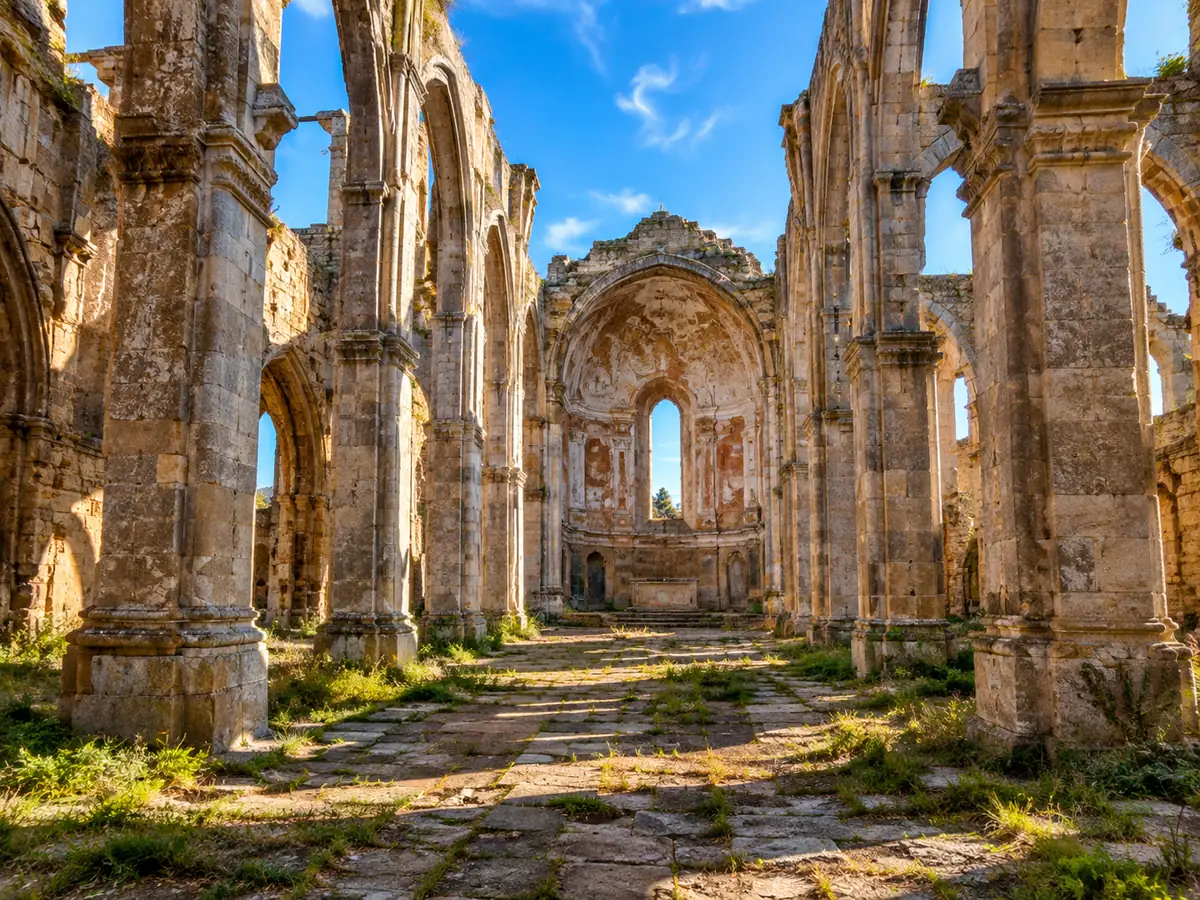
You reach the remains of the Temple of the Sun and the temple balcony, and then to the stop that lingers in your memory just as much as the cemetery: the Cathedral of the Assumption. It was built after the 1301 Arso eruption on top of an earlier chapel, which became its crypt. On 27 December 1509 Vittoria Colonna and Ferrante d’Avalos , Marquis of Pescara, were married here. Between 25 June and 21 August 1809, it was bombarded and destroyed by the British, and the rubble was never cleared—so today, you walk through it under the open sky, with grass growing between the pillars. Restoration work is underway on the 18th-century stuccoes. Beneath it lies the Noble Crypt, and then the panoramic loggia before exiting.
Walk through the last gate of the gallery, the one where the drawbridge used to be, and you’ll find yourself on the bridge with the village ahead. If you want the historical thread that ties all these stops together—from the fifth century BC to today—it’s in the castle’s history; if you’re still deciding whether to climb up, my answer is in it’s worth it.
Wear closed shoes with a grippy sole. Most of the route is outdoors, there are lots of steps, and the stone in the alleys has been smoothed by centuries of footsteps. Pets are allowed, but consider their paws on the scorching stone in August.
The stops no one expects
What works
- The Nuns' Cemetery: the room everyone talks about on the way out
- The roofless Cathedral of the Assumption, bombed in 1809
- The 300-degree view from the Terrace of the Olive Trees
- The Sentiero del Sole, with prickly pears overlooking the sea
- Art exhibitions in the never-plastered church
Worth knowing
- You can’t visit the Maschio: the towers are only visible from the outside
- There are lots of steps, and the San Cristoforo Staircase is steep
- Almost everything is outdoors: rain makes the route uncomfortable
- The two cafés and the bookshop may have different opening hours to the castle
- You can’t complete the tour in under an hour and a half
The twenty-five stops, told by those who know them best
The €40 guided tour adds the 2,500 years the signs can’t capture to the stops, and continues into Borgo di Celsa; Siegfried writes that father and son lead it with genuine passion, and you’ll never get bored.
Frequently asked questions
What’s inside the Aragonese Castle?
Twenty-five stops along nearly two kilometres: the Church of the Immaculate Conception, the Clarisse convent with the Nuns' Cemetery, the Bourbon prison, the roofless Cathedral of the Assumption, the Path of the Sun, and two panoramic cafés. Tickets are available in this page.
Can you go up the Maschio?
No, the fortified tower isn’t part of the visitor route—you can only see it from the outside from the Olive Terrace. It’s the only major section that stays closed.
How long does it take to see everything?
About an hour and a half if you walk at a relaxed pace, not counting café stops. If you’re short on time, I explain how to shorten the visit in how long the visit takes.
What’s the most impressive part?
The Nuns' Cemetery, hands down—the rooms of the *scolatoi* (mortuary chambers) beneath the Church of the Immaculate Conception. I cover it in detail in this page.
Is the route covered?
Hardly at all—most of it is outdoors, between terraces, alleys, and paths. Wear comfy shoes, bring water in summer, and check the weather before leaving from Ischia Porto.